
Last updated: September 28, 2026
Quick Answer
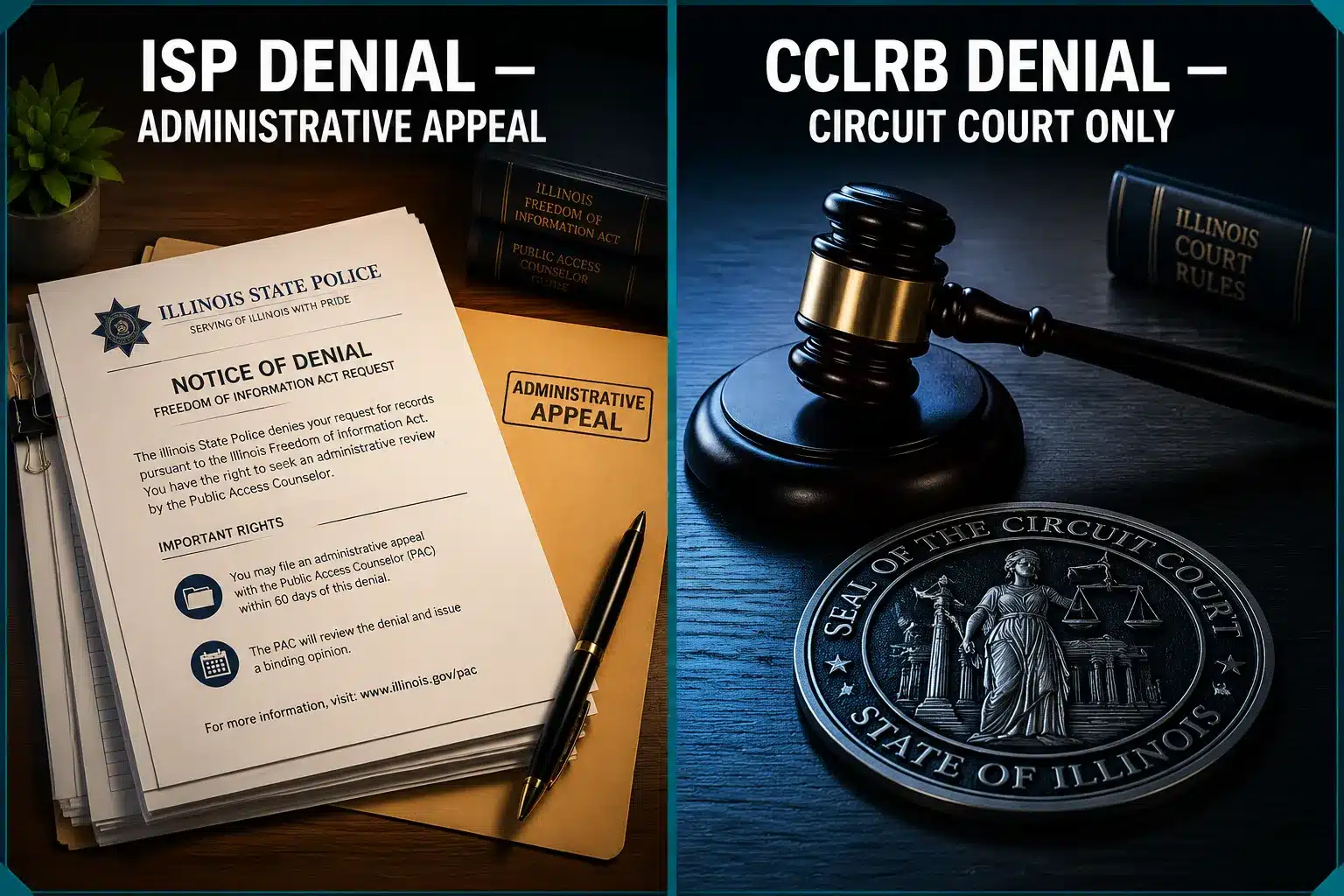
Illinois residents who have their CCL denied or suspended have a statutory right to appeal, but the process depends entirely on who made the decision. If the Illinois State Police (ISP) denied or suspended your license, you have 60 days to file an administrative appeal directly with the ISP. If the Concealed Carry Licensing Review Board (CCLRB) made the decision, your only option is to file a petition in circuit court. Missing the deadline or filing with the wrong authority can permanently close your appeal window.
Key Takeaways
- There are two separate appeal paths: one for ISP decisions and one for CCLRB decisions.
- The ISP appeal deadline is 60 days from the date of the denial or suspension notice.
- CCLRB denials cannot be appealed through the ISP; they must go directly to circuit court.
- You cannot legally carry a firearm while your CCL appeal is pending.
- The ISP appeal process has two stages: informal review, then a formal hearing if needed.
- Missing the 60-day deadline with the ISP typically ends your administrative appeal rights for that denial.
- Mental health adjudications and certain criminal convictions are among the most common reasons for denial.
- You are not required to hire a lawyer, but legal representation significantly improves outcomes in formal hearings.
- Filing fees for circuit court appeals vary by county; ISP administrative appeals do not carry a standard fee.
- If the ISP fails to act on your application within 90 days, you may treat that inaction as a denial and appeal.
What Is the Difference Between a CCL Denial and a Suspension in Illinois
A denial means the ISP or CCLRB refused to issue a CCL after reviewing your application. A suspension means a license was already issued but has been temporarily revoked, often because of a new disqualifying event such as a domestic violence order of protection, a FOID card suspension, or a pending felony charge.
The distinction matters because the appeal process and timeline can differ slightly. A denial triggers the right to appeal the initial decision. A suspension may require both challenging the underlying reason (for example, contesting an order of protection) and filing a separate CCL appeal. For more on how navigating concealed carry Chicago regulations works in practice, that resource covers local compliance requirements that often intersect with license status.
How Do You Know If Your CCL Was Denied or Suspended
The ISP is required to send written notice of any denial, suspension, or revocation. That notice will identify the reason for the action and, in most cases, reference the specific statutory basis. Check your ISP online account portal as well, since status updates appear there before physical mail arrives.
If you never received a notice and your application has been pending for more than 90 days without action, Illinois law treats that inaction as a constructive denial, and you may file an appeal on that basis.
What Are the Main Reasons Illinois Denies Concealed Carry License Applications
The ISP or CCLRB denies CCL applications when an applicant fails to meet one or more statutory eligibility requirements under the Firearm Concealed Carry Act (430 ILCS 66). The most common disqualifying factors include:
- Felony convictions of any class (see the guide to felony classes in Illinois for a breakdown of how convictions are categorized)
- Domestic violence convictions or active orders of protection (see domestic battery defenses in Illinois for context on how these charges are handled)
- Mental health adjudications or voluntary admissions to a mental health facility within the past five years
- Drug-related convictions, including certain misdemeanor drug offenses (see drug charges in Illinois for specifics)
- DUI convictions within the past five years
- Revoked or suspended FOID card at the time of application
- Objections filed by a law enforcement agency that are then reviewed by the CCLRB
The CCLRB specifically handles cases where a law enforcement agency has filed a formal objection to an applicant’s license. That board reviews the objection and either approves or denies the application. Its decisions are not subject to ISP administrative review.
How to Appeal a Concealed Carry License (CCL) Denial or Suspension in Illinois: The Two Paths
The appeal path for a CCL denial or suspension in Illinois depends entirely on who made the decision. Getting this wrong is the single most common procedural mistake applicants make.
Path 1: ISP Administrative Appeal
Use this path when the ISP denied or suspended your license based on a disqualifying record, a failed background check, or a FOID-related issue, and no CCLRB objection was involved.
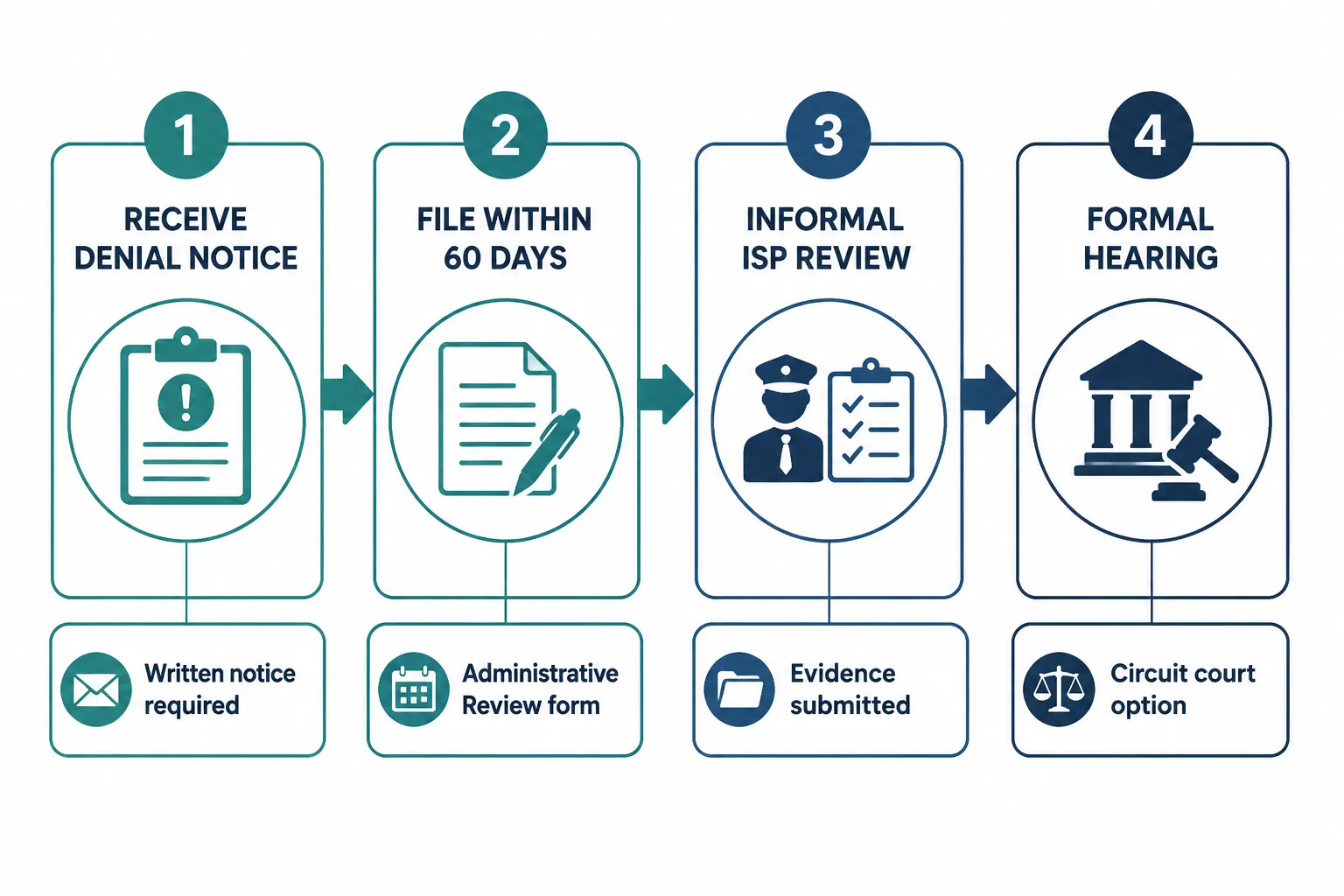
- Obtain the ISP’s “Request for CCL Administrative Review” form from the ISP Firearms Services Bureau website.
- Complete the form and attach all supporting documentation (see the next section for a full list).
- Submit the form within 60 days of the denial or suspension notice.
- The ISP conducts an informal review. If the issue is not resolved at that stage, you may request a formal hearing before an administrative law judge.
- If the formal hearing also results in an unfavorable decision, you may then petition the circuit court for judicial review.
Path 2: Circuit Court Petition (CCLRB Denials Only)
If the CCLRB denied your application after a law enforcement objection, you cannot use the ISP administrative appeal process. You must file a petition for administrative review in the circuit court of the county where you reside. The 2025 appellate decision in Horowitz v. Illinois Concealed Carry Licensing Review Board confirmed that circuit court is the exclusive venue for challenging CCLRB decisions.
How Long Do You Have to Appeal a CCL Denial in Illinois
The statutory deadline for filing an ISP administrative appeal is 60 days from the date on the denial or suspension notice. For circuit court petitions challenging CCLRB decisions, the Administrative Review Law generally requires filing within 35 days of the final agency decision, though applicants should confirm the current deadline with an attorney because procedural rules can shift.
What happens if you miss the deadline: Missing the 60-day ISP window typically forfeits your right to administrative review for that specific denial. You would need to reapply from scratch, and the same disqualifying issue will likely result in another denial unless the underlying problem has been resolved. Missing the circuit court deadline for a CCLRB appeal has the same effect: the denial becomes final.
What Documents Do You Need to Submit for a CCL Appeal
A complete ISP administrative appeal package should include the following:
| Document | Purpose |
|---|---|
| Completed ISP Administrative Review form | Triggers the formal appeal process |
| Copy of the denial or suspension notice | Establishes the basis for the appeal |
| Copy of your FOID card (if applicable) | Confirms current FOID status |
| Court disposition records | Challenges or clarifies criminal history entries |
| Mental health records (if relevant) | Rebuts mental health disqualifications |
| Character letters from employers or community members | Supports fitness for licensure |
| Medical documentation | Addresses health-related disqualifications |
| Any law enforcement clearance letters | Relevant if charges were dismissed or expunged |
Incomplete submissions are a leading cause of delayed or denied appeals. Submit certified copies of court records, not photocopies, whenever possible.
How Much Does It Cost to Appeal a Concealed Carry License Denial
ISP administrative appeals do not carry a standard filing fee. The primary costs are attorney fees if you choose to hire legal representation, plus any costs associated with obtaining certified court records or medical documentation.
Circuit court petitions for CCLRB denials do involve court filing fees, which vary by county. In Cook County, standard administrative review filing fees apply, typically in the range of a few hundred dollars, though applicants should verify current fee schedules directly with the clerk’s office. Attorney fees for a formal hearing or circuit court petition can range considerably depending on the complexity of the case.
Can You Carry a Gun While Your CCL Appeal Is Pending
No. A pending CCL appeal does not grant any right to carry a concealed firearm. Until the ISP issues or reinstates a valid CCL, carrying a concealed weapon is illegal under Illinois law. Doing so while an appeal is pending could result in serious criminal charges that would permanently disqualify you from ever obtaining a CCL. For context on the consequences of unlawful carry, see understanding UUW in Illinois.
Can Mental Health Issues Get Your CCL Appeal Denied in Illinois
Yes, and mental health disqualifications are among the most difficult to overcome on appeal. Illinois law disqualifies applicants who have been adjudicated as a mental defective, involuntarily committed to a mental health facility, or who have voluntarily admitted themselves to a mental health facility within the past five years.
On appeal, the applicant must present credible medical evidence that the disqualifying condition no longer exists or that the historical record is inaccurate. This typically requires a current evaluation from a licensed mental health professional. The ISP or administrative law judge weighs that evidence against the original record. Simply asserting that you are now well is not sufficient; documented clinical support is required.
Do You Need a Lawyer to Appeal a CCL Denial or Suspension in Illinois
You are not legally required to hire an attorney for an ISP administrative appeal, but legal representation materially improves outcomes, particularly at the formal hearing stage. An experienced firearms attorney can identify procedural errors in the denial, gather and present evidence effectively, cross-examine witnesses, and ensure that the administrative record is properly preserved for any subsequent circuit court review.
For CCLRB denials that must go directly to circuit court, the procedural complexity of administrative review litigation makes attorney representation strongly advisable. A Chicago gun lawyer who handles Illinois firearms licensing matters will be familiar with both the CCLRB’s review standards and the applicable court procedures.
How Long Does the CCL Appeal Process Take in Illinois
ISP informal reviews typically take 60 to 90 days after a complete submission is received. If the matter proceeds to a formal hearing, the total timeline can extend to six months or longer. Circuit court petitions challenging CCLRB decisions follow standard administrative review litigation timelines, which can range from several months to over a year depending on the court’s docket and the complexity of the case.
Delays are common when documentation is incomplete or when the underlying disqualifying record requires correction through a separate court process, such as an expungement or a motion to correct a criminal history record.
How to Appeal a Concealed Carry License (CCL) Denial or Suspension in Illinois: Common Mistakes to Avoid
Applicants who handle their own appeals frequently make errors that are difficult or impossible to correct later. The most common mistakes include:
- Filing with the wrong authority. Sending an ISP appeal form when the denial came from the CCLRB wastes time and does not preserve your appeal rights.
- Missing the 60-day deadline. Even one day late is typically fatal to an ISP administrative appeal.
- Submitting incomplete documentation. An appeal without supporting evidence is almost always denied at the informal review stage.
- Failing to address the specific disqualifying reason. A general statement of good character does not rebut a specific statutory disqualification.
- Carrying while the appeal is pending. This creates a new criminal charge that will end any realistic chance of obtaining a CCL.
- Not preserving the administrative record. If you plan to seek circuit court review after a formal hearing, the record created during the administrative process is critical.
Where Do You Submit a CCL Appeal in Illinois
For ISP administrative appeals, submit the completed Request for CCL Administrative Review form and all supporting documents to the Illinois State Police Firearms Services Bureau. The ISP’s official website provides current mailing addresses and, in some cases, electronic submission options. Always send submissions by certified mail with return receipt so you have proof of timely filing.
For CCLRB denials, file your petition for administrative review in the circuit court of the county where you reside. The clerk of the circuit court can provide the correct filing procedures and fee schedules for your county.
Frequently Asked Questions
Can I reapply for a CCL instead of appealing? Yes, but reapplying without resolving the underlying disqualifying issue will result in the same denial. An appeal is the appropriate mechanism to challenge the decision. Reapplication makes more sense after the disqualifying condition has been legally resolved, such as after a successful expungement.
Does a FOID card suspension automatically suspend my CCL? Yes. Illinois law ties CCL eligibility to active FOID card status. If your FOID is suspended or revoked, your CCL is also suspended. You must resolve the FOID issue before your CCL can be reinstated.
Can I appeal a CCL suspension more than once? There is no statutory limit on the number of times you can appeal separate suspension events. However, if the same disqualifying condition keeps recurring, repeated appeals become less viable. Each new suspension triggers a new appeal right and a new deadline.
What if the ISP does not respond to my appeal within a reasonable time? Unreasonable delay by the ISP can be challenged through a mandamus action in circuit court, which compels the agency to act. This is a relatively advanced legal remedy and generally requires attorney assistance.
Does an arrest without conviction disqualify me from a CCL? An arrest alone is not a disqualifying event under the Firearm Concealed Carry Act. However, a pending felony charge will typically result in a suspension or denial until the case is resolved. A conviction, even for certain misdemeanors, may disqualify you.
Can an out-of-state CCL holder appeal an Illinois denial? Illinois does not currently recognize reciprocity with other states for CCL purposes. Out-of-state holders who are denied an Illinois CCL follow the same appeal process as Illinois residents. For more on how Illinois handles out-of-state carry situations, see Chicago gun arrest out of state conceal carry license.
What happens to my gun if my CCL is suspended? A CCL suspension does not automatically require you to surrender your firearms, but it does prohibit concealed carry. If your FOID is also suspended, you may be required to transfer your firearms to a licensed dealer or another eligible person. Retaining firearms while your FOID is suspended is a separate criminal offense.
Is a CCL denial the same as a FOID denial? No. They are separate licenses governed by different statutes. A FOID denial or revocation will, however, automatically disqualify you from obtaining or keeping a CCL. The two appeals are handled through different processes.
Conclusion
Appealing a CCL denial or suspension in Illinois is a structured legal process with firm deadlines and two distinct tracks depending on who made the decision. The most critical steps are identifying whether the ISP or the CCLRB issued the denial, filing within the applicable deadline, and submitting a complete evidentiary package that directly addresses the specific disqualifying reason.
Actionable next steps:
- Read your denial or suspension notice carefully and identify the issuing authority (ISP or CCLRB).
- Mark your calendar immediately: 60 days for ISP appeals, 35 days for CCLRB circuit court petitions.
- Gather certified court records, medical documentation, and any other evidence that rebuts the stated reason for denial.
- Consult a qualified Illinois firearms attorney, especially if the denial involves a CCLRB objection, a mental health record, or a prior conviction.
- Do not carry a firearm while the appeal is pending under any circumstances.
Taking these steps promptly gives you the best realistic chance of reversing a denial or suspension and obtaining the CCL you applied for.