
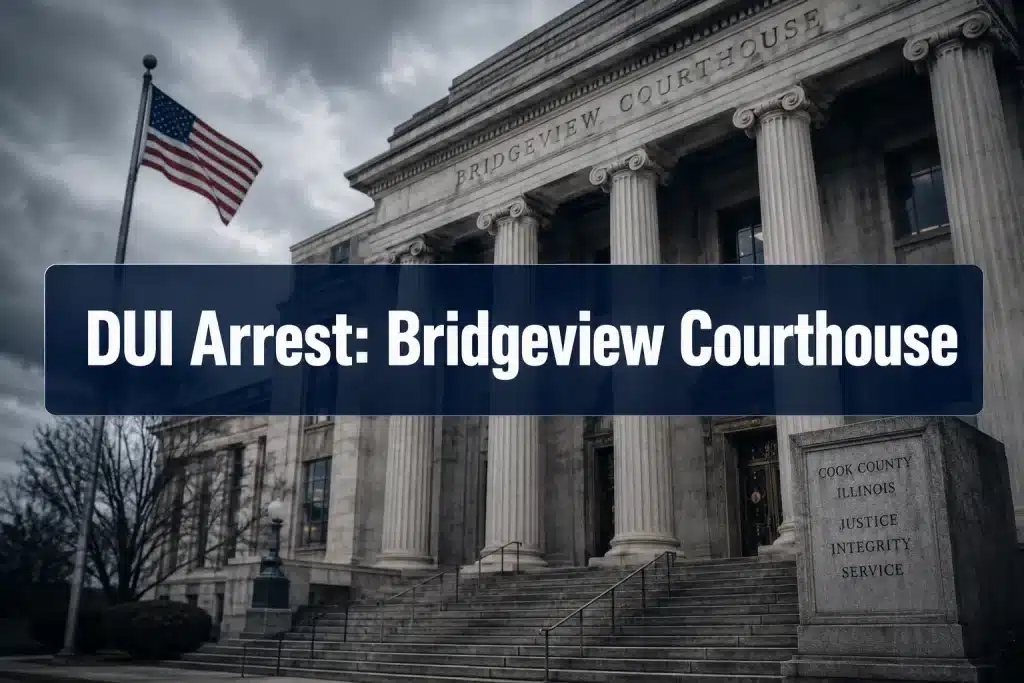

Last updated: July 31, 2026
Quick Answer: If you were arrested for DUI in the southwest suburbs of Cook County, your case will be heard at the Bridgeview Courthouse, the Fifth Municipal District of the Circuit Court of Cook County, located at 10220 S. 76th Avenue, Bridgeview, IL 60455. [1] Your first court date will likely be an arraignment where you enter a plea. Illinois DUI penalties range from license suspension and fines to potential jail time, and the outcome depends heavily on the strength of your defense strategy from day one.
Key Takeaways
- Bridgeview Courthouse handles DUI cases from southwest suburbs including Oak Lawn, Orland Park, Palos Hills, and Burbank. [1]
- Your first appearance is typically an arraignment, not a trial. You will enter a plea and learn your conditions of release.
- A first-offense DUI in Illinois is a Class A misdemeanor carrying up to 364 days in jail, fines up to $2,500, and a minimum one-year license suspension. [4]
- Illinois does not have a separate DWAI charge, DUI is the controlling offense regardless of impairment level.
- Breathalyzer results can be challenged. Equipment calibration errors, improper administration, and medical conditions are all proven defense angles.
- A second or third DUI carries dramatically harsher penalties, including mandatory minimum jail time and potential felony charges. [4]
- Hiring a DUI lawyer with local experience at Bridgeview Courthouse is not optional if you want to protect your record, your license, and your livelihood.
- A DUI conviction can affect professional licenses, security clearances, and employment, the consequences extend far beyond court.

What Happens at Your First DUI Court Appearance in Bridgeview
Your first appearance at Bridgeview Courthouse is called an arraignment. The judge will formally read the charges against you, and you will enter a plea of guilty or not guilty. In most DUI cases, the immediate move is to plead not guilty, this preserves every option and gives your attorney time to review the evidence.
At this hearing, the court may also address:
- Bond conditions, whether you were released after arrest and any restrictions attached
- Statutory Summary Suspension, an automatic license suspension triggered by a failed or refused breath test, separate from any criminal penalty
- Next court date, the arraignment sets the calendar for future hearings
The Bridgeview Courthouse operates Monday through Friday, approximately 8:30 a.m. to 4:30 p.m. [6] For case-specific scheduling, contact the Clerk of the Circuit Court at Bridgeview directly at 708-974-6500. [2]
For a broader look at what follows an arrest in Cook County, see this guide on what happens after a DUI arrest in Chicago.
Common mistake: Many defendants assume the arraignment is low-stakes. It is not. Showing up without an attorney, or entering the wrong plea under pressure, can limit your options for the entire case.
How Long Does a DUI Case Take in Cook County
A DUI case in Cook County typically takes three months to over a year to resolve, depending on whether it goes to trial. Most cases that settle through a plea agreement resolve faster, sometimes in two to four court dates. Cases that involve contested evidence, trial, or complex facts take longer.
Factors that affect the timeline:
- Whether you contest the breathalyzer or field sobriety results
- The court’s docket at Bridgeview
- Whether a statutory summary suspension hearing is requested (must be filed within 90 days of arrest)
- Prior DUI history, which may trigger additional hearings
The statutory summary suspension is a separate administrative process from the criminal case. You have a narrow window to fight it, missing that deadline means automatic suspension for up to three years on a refusal. [4]
What Are the Typical DUI Penalties in Illinois
Illinois DUI penalties escalate sharply with each offense. Here is what defendants face under Illinois law: [3][4]
| Offense | Classification | Jail | Fine | License Suspension |
|---|---|---|---|---|
| 1st DUI | Class A Misdemeanor | Up to 364 days | Up to $2,500 | Minimum 1 year |
| 2nd DUI | Class A Misdemeanor | Mandatory minimum 5 days or 240 hrs community service | Up to $2,500 | Minimum 5 years |
| 3rd DUI | Class 2 Felony | 3-7 years possible | Up to $25,000 | 10-year revocation |
| DUI with injury | Class 4 Felony (or higher) | 1-3 years (or more) | Varies | Revocation |
Additional penalties may include mandatory alcohol evaluation, treatment programs, installation of a Breath Alcohol Ignition Interlock Device (BAIID), and vehicle registration suspension.
For a full breakdown, review this detailed guide on Illinois DUI penalties explained.
Do You Need a DUI Lawyer, or Can You Represent Yourself
Representing yourself in a DUI case at Bridgeview Courthouse is legally allowed but rarely wise. A DUI is a criminal charge, not a traffic ticket. The consequences include a permanent criminal record, license revocation, and potential jail time.
An experienced DUI defense attorney with local experience at Bridgeview can:
- Challenge the legality of the traffic stop
- Contest breathalyzer calibration and administration
- File motions to suppress improperly obtained evidence
- Negotiate a reduction or dismissal of charges
- Fight for a monitoring device driving permit to keep you on the road
The question is not whether you can represent yourself. The question is whether you can afford the consequences of doing it poorly. For context on what a criminal defense attorney actually does in court, see what a criminal defense attorney in Chicago really does.
What’s the Difference Between DUI and DWAI in Illinois
Illinois does not have a separate DWAI (Driving While Ability Impaired) charge. The controlling offense is DUI, Driving Under the Influence, under 625 ILCS 5/11-501. [4] A driver can be charged with DUI if their blood alcohol content (BAC) is 0.08% or higher, or if any amount of alcohol or drugs impairs their ability to drive safely, regardless of BAC.
This matters because even a BAC below 0.08% can result in a DUI charge if the officer observed impaired driving. There is no lesser “impairment” charge to fall back on in Illinois.
How Much Does a DUI Lawyer Cost in the Southwest Suburbs
DUI attorney fees in the southwest suburbs vary based on case complexity, the attorney’s experience, and whether the case goes to trial. General estimates (not guarantees):
- Misdemeanor DUI (first offense, plea): $1,500,$5,000
- Misdemeanor DUI (contested, motions): $3,500,$8,000
- Felony DUI or trial: $7,500,$20,000+
Many attorneys offer free initial consultations. The cost of not hiring a lawyer, a permanent criminal record, lost license, job loss, almost always exceeds the cost of aggressive representation. For guidance on finding the right fit, see why hire a criminal defense lawyer.
Can You Get a DUI Dismissed at Bridgeview Courthouse
Yes, DUI charges can be dismissed at Bridgeview Courthouse, though it requires a proven defense strategy and strong legal work. Dismissals happen when:
- The traffic stop lacked reasonable suspicion
- Breathalyzer results are suppressed due to equipment or procedural errors
- Field sobriety tests were administered incorrectly
- Chain of custody for blood samples was broken
- Constitutional violations occurred during the arrest
Even when outright dismissal is not possible, charges can often be reduced. An attorney with local experience at Bridgeview knows the prosecutors, the judges, and the tendencies of this specific courthouse, that knowledge produces better results.

How Does the Breathalyzer Test Work, and Can It Be Wrong
A breathalyzer estimates blood alcohol content by measuring alcohol in exhaled breath and applying a mathematical conversion. The device assumes a fixed breath-to-blood ratio of 2,100:1, but that ratio varies significantly between individuals. [9]
Breathalyzer results can be wrong due to:
- Improper calibration, devices must be regularly tested and certified
- Mouth alcohol contamination, from burping, vomiting, or dental work
- Medical conditions, diabetes, acid reflux, and certain diets can produce false readings
- Radio frequency interference, from police radios or cell phones near the device
- Improper administration, officers must observe the subject for 20 minutes before testing
Challenging breathalyzer results is one of the most effective defense strategies available. For related insight on how physical evidence is evaluated, see this guide on field sobriety test clues and what they mean.
What Happens If This Is Your Second or Third DUI Offense
A second DUI in Illinois triggers mandatory minimum jail time (at least 5 days) or 240 hours of community service, a five-year minimum license revocation, and potential vehicle forfeiture. [4] A third DUI is a Class 2 felony, the case moves to felony court, and the stakes increase dramatically.
For defendants facing multiple DUI offenses, the defense strategy must be immediate and aggressive. Evidence challenges, constitutional motions, and mitigation arguments all become more critical when mandatory minimums are on the table. See the full breakdown of multiple DUI convictions in Illinois.
Can You Get Your License Back After a DUI Arrest
Yes, but the path depends on whether you are dealing with a statutory summary suspension or a full revocation after conviction.
- Statutory Summary Suspension: You can request a Judicial Driving Permit (JDP) or a Monitoring Device Driving Permit (MDDP) to drive with a BAIID installed during the suspension period.
- After conviction: You must petition the Secretary of State for reinstatement, which requires a formal hearing, proof of alcohol evaluation and treatment, and often years of compliance.
Acting fast matters. The window to contest a statutory summary suspension is 90 days from arrest. Missing it eliminates your best chance to keep driving while the criminal case is pending.
What Should You Bring to Your DUI Court Date
Arriving prepared at Bridgeview Courthouse protects your case and demonstrates respect for the court.
Bring the following:
- Government-issued photo ID
- Your bond paperwork or release conditions document
- Any paperwork from your arrest (ticket, notice to appear, bond slip)
- Contact information for your attorney (or confirmation of your attorney’s appearance)
- Appropriate clothing, business casual or better; appearance signals seriousness
Do not bring: weapons, prohibited items, or anyone who might create a disturbance. Arrive early, courthouse security lines can be slow.
What’s the Process for a DUI Plea Bargain
A DUI plea bargain involves negotiating with the prosecutor to resolve the case without a full trial. In Cook County, this might mean:
- Charge reduction, DUI reduced to reckless driving (“wet reckless”), which carries fewer long-term consequences
- Agreed sentencing, pleading guilty to DUI in exchange for a specific, agreed sentence (no jail, supervision, etc.)
- Supervision, a first-time offender may qualify for court supervision, which keeps the conviction off the public record if completed successfully
Not every case qualifies for a plea reduction. Prosecutors at Bridgeview weigh the evidence, your history, and the circumstances of the stop. An attorney who knows this courthouse and its prosecutors is in the best position to negotiate effectively.
Will a DUI Conviction Affect Your Job
A DUI conviction can affect employment in several concrete ways:
- Professional licenses, nurses, teachers, CDL drivers, lawyers, and others face licensing board scrutiny
- Background checks, most employers run checks; a DUI conviction is a criminal record entry
- Security clearances, federal and state clearance holders may face review or revocation
- Commercial driving, a CDL holder convicted of DUI faces disqualification under federal law
- Current employment, some employers have conduct policies that treat criminal convictions as terminable offenses
Court supervision (available for first-time offenders) is not a conviction and does not appear as a conviction on a background check, making it one of the most valuable outcomes to fight for.
What Are the Most Common Mistakes People Make in DUI Cases
These mistakes consistently damage DUI cases, and most are avoidable:
- Talking to police without an attorney present. Anything said during or after the stop can be used against you. Stay polite, but stay silent beyond identifying yourself.
- Missing the 90-day window to contest the statutory summary suspension. This deadline is firm. Missing it means automatic suspension.
- Assuming the breathalyzer result is unbeatable. It is not. Results are challenged and suppressed regularly.
- Hiring a general practice attorney instead of a DUI-focused defense lawyer. Local experience at Bridgeview Courthouse matters.
- Posting about the arrest on social media. Screenshots are evidence.
- Missing a court date. A warrant will be issued immediately. This makes everything worse.
- Waiting too long to hire an attorney. The earlier a defense strategy is built, the more options remain available.
For immediate guidance after an arrest, review what to do after you are arrested.
FAQ: Arrested for DUI in the Southwest Suburbs? What to Expect at Bridgeview Courthouse
Q: Where is the Bridgeview Courthouse located? A: The Bridgeview Courthouse, Cook County’s Fifth Municipal District, is at 10220 S. 76th Avenue, Bridgeview, IL 60455. It handles DUI and criminal cases from southwest suburbs including Oak Lawn, Orland Park, Palos Hills, and Burbank. [1]
Q: What is the phone number for the Bridgeview Courthouse clerk? A: The Clerk of the Circuit Court at Bridgeview can be reached at 708-974-6500 for case-specific information including court dates and filing questions. [2]
Q: Can a first-time DUI be expunged in Illinois? A: No. A DUI conviction cannot be expunged in Illinois. However, if you receive court supervision and complete it successfully, the arrest does not result in a conviction and may be eligible for expungement under certain conditions.
Q: What is a statutory summary suspension? A: It is an automatic administrative suspension of your driver’s license triggered by a failed breath test (BAC of 0.08% or higher) or a refusal to test. It is separate from any criminal penalty and takes effect 46 days after your arrest. [4]
Q: What happens if I refuse the breathalyzer? A: Refusal triggers a longer statutory summary suspension, three years for a first offense versus six months for a failed test. Refusal can also be used as evidence of consciousness of guilt at trial. [4]
Q: Is a DUI a felony in Illinois? A: A first or second DUI is typically a Class A misdemeanor. A third DUI or a DUI involving aggravating factors (injury, child passenger, no valid license) becomes a felony. [4]
Q: How do I fight a DUI charge in Cook County? A: The most effective strategies involve challenging the legality of the stop, contesting breathalyzer or field sobriety test results, filing suppression motions, and negotiating with prosecutors. An attorney with local experience at Bridgeview is essential for this process.
Q: What is a “wet reckless” in Illinois? A: A “wet reckless” is a reckless driving charge that results from a DUI plea negotiation. It carries fewer penalties than a DUI conviction and does not trigger the same license consequences, but it is not available in every case.
Q: Can I drive after a DUI arrest? A: Possibly. A Monitoring Device Driving Permit (MDDP) allows you to drive during a statutory summary suspension if you install a BAIID in your vehicle. Eligibility depends on your offense history.
Q: What courts does Bridgeview Courthouse serve? A: Bridgeview is the Fifth Municipal District of the Circuit Court of Cook County. It serves southwest suburban communities and handles traffic, misdemeanor, and some felony matters for that district. [1][6]
Conclusion
Being arrested for DUI in the southwest suburbs is serious, but it is not the end of the road. The Bridgeview Courthouse process is navigable when you know what to expect and move quickly to protect your rights. From contesting the statutory summary suspension to challenging breathalyzer evidence and negotiating with prosecutors, every step of this case offers an opportunity to fight for a better outcome.
The most important action you can take right now is to hire an attorney with proven local experience at Bridgeview Courthouse before your first court date. Do not wait. Do not guess. And do not assume the evidence against you is airtight.
Immediate next steps:
- Contact a DUI defense attorney with Cook County experience today, not after your first court date.
- Write down everything you remember about the stop, the arrest, and the breathalyzer test while it is fresh.
- Do not discuss your case on social media or with anyone other than your attorney.
- Note your arrest date and count 90 days forward, that is your deadline to contest the statutory summary suspension.
- Gather your bond paperwork, release conditions, and any documents you received at arrest.
For a complete overview of the DUI process in Illinois, see navigating the DUI process in Illinois.
References
[1] Bridgeview Courthouse – https://www.cookcountycourtil.gov/location/bridgeview-courthouse
[2] Cook County Clerk of Court – https://www.cookcountyclerkofcourt.org/node/1301
[3] Illinois DUI Penalty Chart 2026 Fines Jail License Suspension – https://www.insureonthespot.com/illinois-dui-penalty-chart-2026-fines-jail-license-suspension/
[4] DUI Penalties – Illinois State Police – https://isp.illinois.gov/TrafficSafety/DuiPenalties
[5] Illinois DUI Penalties Explained – https://chicagopremierattorney.com/illinois-dui-penalty-chart/
[6] Location List – Cook County Courts – https://www.cookcountycourtil.gov/location-list


