

Last updated: July 25, 2026
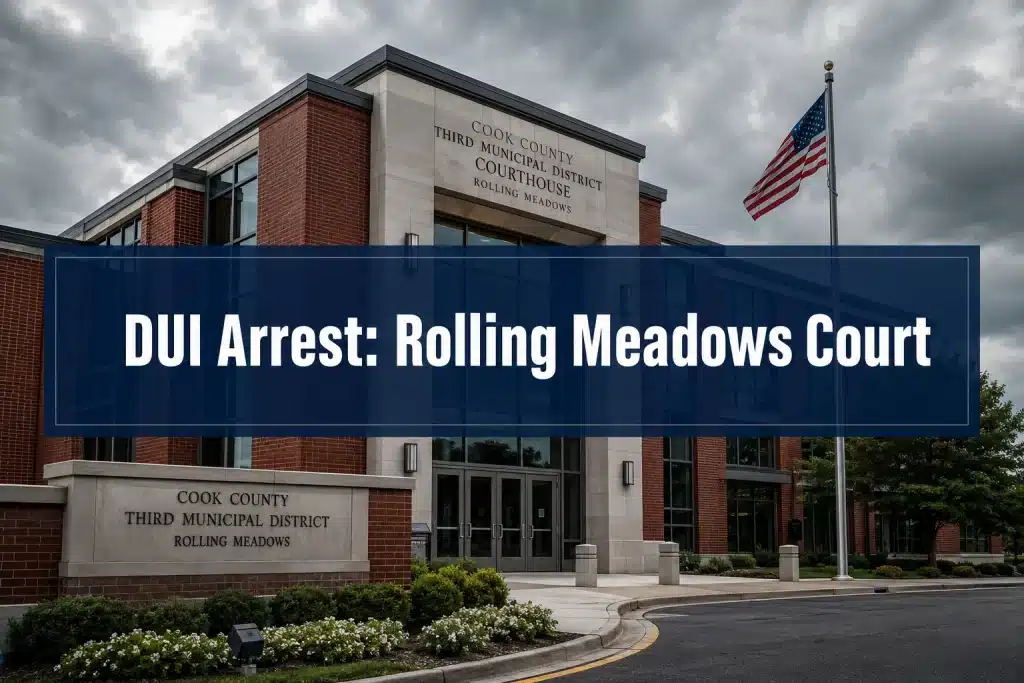
Quick Answer: If you were arrested for DUI in communities like Schaumburg, Arlington Heights, Mount Prospect, or Palatine, your case will almost certainly be heard at the Rolling Meadows Courthouse, the Third Municipal District of Cook County, located at 2121 Euclid Avenue, Rolling Meadows, IL 60008. Your first court appearance is the arraignment, where charges are formally read and you enter a plea. What happens next depends heavily on the strength of the evidence, your prior record, and whether you have an aggressive local attorney fighting for you from day one.
Key Takeaways
- Being arrested for DUI in the Northwest Suburbs means your case goes to Rolling Meadows Courthouse, not downtown Chicago.
- The courthouse handles both misdemeanor and felony DUI cases, with separate courtrooms for each.
- A first-offense DUI in Illinois is typically a Class A misdemeanor, but aggravating factors can elevate it to a felony.
- Illinois has no “DWAI” charge, the DUI statute covers all impaired driving, with a 0.08% BAC legal limit.
- You can refuse a breathalyzer, but Illinois’s implied consent law means automatic license suspension for doing so.
- Dismissals are possible in Cook County when evidence is weak, stops were unlawful, or testing procedures were flawed.
- Missing a court date triggers an automatic warrant, immediate action is required.
- Local experience matters: an attorney who knows Rolling Meadows judges and prosecutors has a proven strategic advantage.
- DUI lawyer costs in the northwest suburbs vary widely; a flat-fee arrangement is common for misdemeanor cases.
- The sooner you retain counsel, the more control you have over your outcome.

How Does the Rolling Meadows Courthouse Handle DUI Cases
The Rolling Meadows Courthouse is the primary venue for DUI prosecutions across the northwest suburbs of Cook County. Municipalities including Schaumburg, Arlington Heights, Mount Prospect, Palatine, and portions of Elgin all send their criminal traffic cases here [3][4].
The building operates Monday through Friday, roughly 8:30 AM to 4:30 PM, with free parking in adjacent lots and a parking garage [1][3]. Typical DUI court call times are 9:00 AM, 10:30 AM, 1:00 PM, and 1:30 PM [3][9]. Felony DUI cases are heard in dedicated courtrooms on the first floor. Misdemeanor DUI cases, the majority of prosecutions, are heard daily across several courtrooms on the first and second floors [6]. For Schaumburg-area cases, felony bond court typically runs at 1:30 PM in Room 108, and misdemeanor bond court at 10:00 AM in the same room [12].
Practical tip: Arrive at least 20 minutes before your scheduled call time. Courtrooms fill quickly, and being late creates a bad first impression with the judge.
What Happens at Your First DUI Court Appearance in Rolling Meadows
Your first appearance is the arraignment. The judge formally reads the charges, and you enter a plea, almost always “not guilty” at this stage, regardless of the circumstances.
Here is what to expect in sequence:
- Check in with the clerk or court officer when you arrive.
- Wait for your case to be called during the court call.
- The judge confirms your identity and reads the charges.
- Your attorney enters a “not guilty” plea on your behalf.
- A next court date is set for pre-trial motions or discovery.
If you were released on your own recognizance after arrest, you may not have had a formal bond hearing. If bond was required, that hearing already occurred before this date. For more on how Cook County handles the period immediately after arrest, see this guide on what happens after a DUI arrest in Chicago.
Common mistake: Showing up without an attorney and attempting to negotiate with the prosecutor directly. Anything you say can and will be used against you.
What Are the Typical DUI Penalties in Rolling Meadows, Illinois
A first-offense DUI in Illinois is a Class A misdemeanor, carrying up to 364 days in jail and fines up to $2,500. Most first-time offenders do not serve jail time, but the collateral consequences are severe.
| Offense Level | Potential Jail Time | Fine Range | License Impact |
|---|---|---|---|
| 1st DUI (misdemeanor) | Up to 364 days | Up to $2,500 | 1-year revocation |
| 2nd DUI (misdemeanor) | Up to 364 days | Up to $2,500 | 5-year revocation |
| 3rd DUI (Class 2 felony) | 3-7 years | Up to $25,000 | 10-year revocation |
| Aggravated DUI (felony) | Varies by class | Varies | Possible lifetime revocation |
Beyond fines and jail, a DUI conviction triggers mandatory driver’s license revocation, potential ignition interlock device requirements, mandatory alcohol evaluation, and possible loss of professional licenses. For a full breakdown, review the consequences of a DUI arrest in Illinois and the DUI penalties page.
What Is the Difference Between DUI and DWAI in Illinois
Illinois does not have a separate DWAI (Driving While Ability Impaired) charge. The state uses a single DUI statute that covers all forms of impaired driving.
Under 625 ILCS 5/11-501, a person commits DUI if they drive with a BAC of 0.08% or higher, or if they are under the influence of alcohol, drugs, or any intoxicating compound to a degree that renders them incapable of safe driving, regardless of BAC [2]. This means you can be convicted even with a BAC below 0.08% if the officer’s observations and field sobriety test results support impairment. Learn more about how field sobriety test clues factor into these cases.
Can You Refuse a Breathalyzer Test in Illinois
Yes, you can physically refuse a breathalyzer. But Illinois’s implied consent law (625 ILCS 5/11-501.1) means refusal carries automatic consequences: a 12-month statutory summary suspension for a first offense, compared to a 6-month suspension for failing the test [2].
Key points:
- Refusal cannot be used as direct evidence of guilt at trial, but prosecutors will argue it shows consciousness of guilt.
- You have 90 days from the date of arrest to challenge the statutory summary suspension through a court petition.
- A Monitoring Device Driving Permit (MDDP) may allow limited driving during the suspension period.
Decision rule: If you have prior DUI convictions, refusal may make strategic sense. For a first offense with a borderline BAC, the calculus is more complex, discuss it with an attorney immediately.
What Are Your Rights During a DUI Traffic Stop
During a DUI stop, you have the right to remain silent beyond providing your name, license, registration, and proof of insurance. You are not required to answer questions about where you were drinking or how much you consumed.
Your key rights:
- Right to remain silent: Invoke it clearly, “I am invoking my right to remain silent.”
- Right to refuse field sobriety tests: FSTs are voluntary in Illinois. Refusing them cannot result in automatic license suspension.
- Right to an attorney: Once arrested, assert this right before any further questioning.
- Fourth Amendment protections: The stop itself must be legally justified. An unlawful stop can result in suppression of all evidence gathered.
For a detailed breakdown of what to do when pulled over, see what to do if you are pulled over for a DUI.
Can You Get a DUI Dismissed in Cook County
Yes, DUI dismissals happen in Cook County, and a skilled attorney will aggressively pursue every available avenue. The most common grounds for dismissal or charge reduction include:
- Unlawful traffic stop: If the officer lacked reasonable suspicion to pull you over, all evidence gathered afterward may be suppressed.
- Improper field sobriety testing: Officers must follow standardized NHTSA protocols. Deviations can undermine the results.
- Breathalyzer calibration issues: Breath testing devices require regular maintenance and calibration. Records can reveal flaws.
- Chain of custody problems: Blood test results can be challenged if proper handling procedures were not followed.
- Insufficient evidence of impairment: If the state cannot prove impairment beyond a reasonable doubt, the case should not survive.
Review common mistakes in DUI cases to understand what can hurt, or help, your defense.
Do You Need a DUI Lawyer for Rolling Meadows Courthouse
Absolutely. Representing yourself in a DUI case at Rolling Meadows is one of the most costly mistakes you can make. The prosecutors there are experienced, the rules of evidence are complex, and the consequences of a conviction follow you for life.
A proven local attorney brings:
- Knowledge of which judges respond to which defense strategies
- Relationships with prosecutors that can open plea negotiation doors
- Immediate ability to file motions to suppress unlawful evidence
- Experience handling the Secretary of State proceedings that run parallel to the criminal case
For context on what a criminal defense attorney actually does in these situations, see what a criminal defense attorney in Chicago really does. For Rolling Meadows-specific representation, a Rolling Meadows criminal defense lawyer with local experience is your strongest asset.
How Much Does a DUI Lawyer Cost in the Northwest Suburbs
DUI attorney fees in the northwest suburbs vary based on case complexity, the attorney’s experience, and whether the case goes to trial. Most misdemeanor DUI cases are handled on a flat fee. Felony DUI cases typically involve higher fees due to the additional work involved.
General ranges (estimates based on market conditions as of 2026):
- First-offense misdemeanor DUI: Flat fees commonly range from $1,500 to $5,000.
- Felony DUI or aggravated DUI: Fees often start at $5,000 and can exceed $15,000 for trial.
- License reinstatement hearings: Typically billed separately; see the formal hearing process for driver’s license reinstatement.
Important: The cost of not hiring a lawyer, a permanent criminal record, lost employment, skyrocketing insurance rates, and potential jail time, almost always exceeds the attorney’s fee. Use the guide to finding the right DUI lawyer near you to evaluate your options.
How Long Does a DUI Case Take in Cook County’s Northwest Suburbs
A straightforward first-offense misdemeanor DUI at Rolling Meadows typically resolves in 3 to 9 months. Cases involving contested motions, trial, or felony charges can take 12 to 24 months or longer.
Factors that extend the timeline:
- Filing and arguing motions to suppress evidence
- Waiting for lab results on blood or urine tests
- Scheduling conflicts in a busy courthouse
- Plea negotiations that require multiple court dates
- Jury or bench trial preparation
Each court date typically advances the case incrementally, discovery exchange, motion hearings, pre-trial conferences, and finally disposition or trial. Your attorney should give you a realistic timeline based on the specific facts of your case.
What If This Is Your Second or Third DUI Offense
The stakes escalate dramatically with repeat offenses. A second DUI conviction in Illinois results in a mandatory minimum 5 days in jail or 240 hours of community service, along with a 5-year license revocation. A third DUI is charged as a Class 2 felony [2].
Additional consequences for repeat offenders:
- Mandatory alcohol/drug treatment programs
- Extended ignition interlock device requirements
- Possible permanent revocation of driving privileges after certain repeat convictions
- Significantly reduced leverage in plea negotiations
If you are facing a second or third charge, the defense strategy must be more aggressive and more immediate. There is no room for delay. Review what to do after a DUI arrest and contact an attorney the same day.
What Should You Bring to Your DUI Court Date in Rolling Meadows
Come prepared. Disorganization signals to the court that you are not taking the matter seriously.
Bring with you:
- A valid photo ID
- Your court summons or notice with the case number and courtroom assignment
- Contact information for your attorney (or your attorney in person)
- Any paperwork related to the arrest, including bond conditions
- Appropriate, professional clothing, dress as if the judge’s impression matters, because it does
Do not bring:
- Weapons of any kind (the courthouse has security screening)
- Food or beverages into the courtroom
- Your phone in active use, silence it before entering the courtroom
Arrive at least 20 minutes early [3]. Courtrooms can be called in any order, and being absent when your name is called creates immediate problems.
What Happens If You Miss Your DUI Court Date
Missing a court date at Rolling Meadows triggers an automatic bench warrant for your arrest. The judge will issue it the moment your name is called and you are not present.
Once a warrant is issued:
- You can be arrested at any time, during a routine traffic stop, at work, or at home.
- Bail may be revoked or increased at the next appearance.
- The judge’s impression of you as a defendant worsens significantly.
- The prosecutor gains leverage in any subsequent negotiations.
If you missed a court date, do not wait. An attorney can often appear on your behalf, file a motion to quash the warrant, and arrange a new court date before you are arrested. Immediate action is the only way to protect yourself in this situation.

How to Find a Good DUI Attorney Near Rolling Meadows
The right attorney has specific experience in Cook County DUI cases, ideally with a track record at the Rolling Meadows Courthouse itself. Local experience is not a luxury, it is a strategic advantage.
When evaluating attorneys, look for:
- Proven results in DUI cases at Rolling Meadows or the Third Municipal District
- Familiarity with the local judges, prosecutors, and court procedures
- A clear explanation of your defense options during the initial consultation
- Transparent fee structure with no surprise billing
- Availability to communicate with you throughout the process
Avoid attorneys who guarantee outcomes or who seem unfamiliar with the specific courthouse. Use the Chicago criminal defense lawyer as a framework for your decision.
Conclusion: Take Control of Your DUI Case at Rolling Meadows
A DUI arrest in the northwest suburbs is serious, but it is not the end of the road. The outcome of your case depends on the decisions you make in the days immediately following your arrest.
Actionable next steps:
- Retain a local DUI attorney immediately. The 90-day window to challenge your statutory summary suspension starts at arrest, not at your first court date.
- Write down everything you remember about the stop, the officer’s instructions, and the testing procedures while the details are fresh.
- Do not discuss your case with anyone other than your attorney, not friends, not family, and certainly not on social media.
- Appear at every court date on time and dressed professionally.
- Follow your attorney’s strategy. An aggressive, proven defense requires trust and coordination.
The Rolling Meadows Courthouse processes hundreds of DUI cases every year. Most defendants walk in without a plan. The ones who fight back with experienced local counsel and a clear strategy are the ones who protect their records, their licenses, and their futures.
Frequently Asked Questions
Q: Where exactly is the Rolling Meadows Courthouse? A: The courthouse is located at 2121 Euclid Avenue, Rolling Meadows, IL 60008. Free parking is available in adjacent lots and a parking garage [1][3].
Q: What suburbs send DUI cases to Rolling Meadows? A: Schaumburg, Arlington Heights, Mount Prospect, Palatine, and parts of Elgin are among the northwest suburbs that send DUI and criminal traffic cases to Rolling Meadows [3][4].
Q: Will I go to jail at my first court appearance? A: Not typically. The arraignment is an administrative hearing where charges are read and a plea is entered. Jail is not a standard outcome at this stage for most first-offense DUI defendants.
Q: Can a DUI be expunged from my record in Illinois? A: No. A DUI conviction cannot be expunged or sealed in Illinois. This makes fighting the charge, rather than simply accepting a plea, critically important.
Q: What is a statutory summary suspension? A: It is an automatic administrative suspension of your driving privileges triggered by either failing or refusing a chemical test at the time of arrest. It is separate from any criminal penalties and must be challenged within 90 days.
Q: Do I need to appear at every court date? A: Yes, unless your attorney specifically arranges a waiver of appearance. Missing any court date without prior arrangement results in a bench warrant.
Q: What is an MDDP? A: A Monitoring Device Driving Permit allows first-time DUI offenders to drive during their statutory summary suspension period, provided they install a breath alcohol ignition interlock device in their vehicle.
Q: Can the DUI charge be reduced to reckless driving? A: In some cases, yes. A “wet reckless” plea (reckless driving involving alcohol) is sometimes available for first-time offenders with borderline BAC results and no aggravating factors. It requires negotiation by an experienced attorney.
Q: How does a DUI affect my driver’s license separately from the criminal case? A: The criminal case and the Secretary of State’s license revocation/suspension proceedings run on parallel tracks. Even if criminal charges are dismissed, the administrative license action may still proceed. An attorney must address both.
Q: What if I was arrested in a suburb but live in a different county? A: Your case is filed in the county where the arrest occurred. If arrested in a Cook County northwest suburb, your case is at Rolling Meadows regardless of where you live.


