


Last updated: July 29, 2026
Quick Answer: If you were arrested for DUI in Cook County, you face two separate battles: a criminal case in court and an administrative fight to save your driver’s license. The criminal process starts with a bond hearing, then arraignment, pretrial motions, and potentially a trial. Your license suspension begins automatically 46 days after your arrest unless you act fast. Time is not on your side, the decisions you make in the first 48 hours matter enormously.
Key Takeaways
- A first-time DUI in Illinois is a Class A misdemeanor, carrying up to 364 days in jail and fines up to $2,500, plus mandatory license revocation [4]
- Your driver’s license faces an automatic statutory summary suspension starting 46 days after your arrest, you have 90 days to petition to rescind it [5]
- Refusing a breathalyzer results in a longer suspension (3 years for a first offense) than failing one (6 months) [5]
- Bond court in Cook County now operates under the Pretrial Fairness Act, cash bail has been eliminated for most DUI cases [1]
- A DUI case in Cook County typically takes 6 to 18 months to resolve, depending on complexity
- A skilled Cook County DUI attorney can challenge the traffic stop, breathalyzer calibration, field sobriety tests, and other evidence
- DUI convictions in Illinois cannot be expunged, this makes fighting the charge aggressively from day one critical
- Aggravated DUI (involving injury, a child passenger, or a fatality) can be charged as a felony with prison time [4]
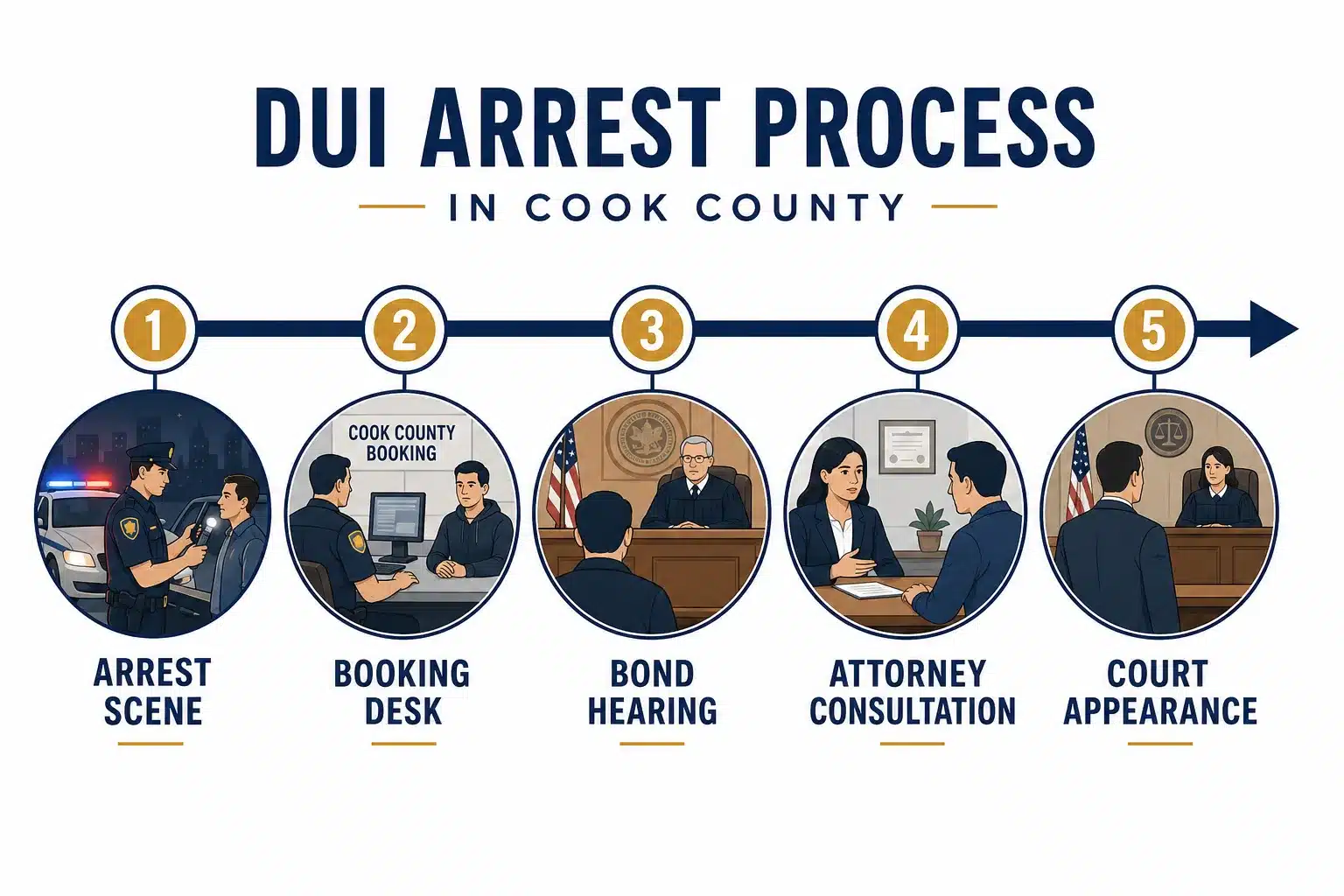
What Are the Steps After Getting Arrested for DUI in Cook County?
When you’re arrested for DUI in Cook County, the process moves through several distinct stages, each with its own deadline and decision point. Understanding the sequence helps you take control instead of reacting blindly.
Here is the typical progression [3][5]:
- Arrest and booking, Police take you into custody, conduct chemical testing (breathalyzer or blood draw), and book you at a local station or Cook County Jail.
- Bond hearing, Under the Pretrial Fairness Act, most first-time DUI defendants are released without cash bail. A judge may impose conditions such as no alcohol consumption or ignition interlock. Learn more about what happens after an arrest in Cook County under the new bond rules.
- Arraignment, You appear before a judge, hear the formal charges, and enter a plea (almost always “not guilty” at this stage).
- Pretrial motions, Your attorney files motions to suppress evidence, challenge the stop, or attack the breathalyzer results. This is where experienced defense strategy can change everything.
- Negotiation or trial, The State’s Attorney may offer a plea deal. If no acceptable offer exists, the case goes to a bench or jury trial.
- Sentencing, If convicted, the judge imposes penalties based on your record, the facts of the case, and statutory guidelines.
Common mistake: Many people assume the process is straightforward and delay hiring an attorney. Waiting even a few days can cost you the chance to challenge your license suspension.
How Long Do You Stay in Jail After a DUI Arrest in Illinois?
Most first-time DUI defendants in Cook County are released within 12 to 24 hours of arrest. Under the Illinois Pretrial Fairness Act, which eliminated cash bail, judges focus on whether you pose a danger or a flight risk, not whether you can pay [1].
For a standard first-offense DUI with no aggravating factors, release typically happens quickly. You may be held longer if:
- You have prior DUI convictions
- The arrest involved an accident with injuries
- You have an active warrant or outstanding charges
- The judge finds you pose a specific risk
For a deeper look at how the Pretrial Fairness Act affects Cook County defendants, including what conditions a judge can impose, that resource covers the full picture.
What Is the Bail Amount for a First-Time DUI in Cook County?
Cash bail has been eliminated in Illinois for most DUI cases under the Pretrial Fairness Act, which took effect in September 2023. For a first-time DUI in Cook County, you will not post a dollar amount to get out, instead, a judge decides whether to release you with or without conditions [1].
Conditions commonly imposed on DUI defendants include:
- No consumption of alcohol or controlled substances
- Mandatory ignition interlock device if driving is permitted
- Regular check-ins with pretrial services
- Surrender of passport in rare cases
Edge case: If the DUI is charged as an aggravated felony, for example, because someone was seriously injured, the State can petition to detain you without release. That is a much higher legal bar, but it does happen.
What Should You Do Immediately After Being Arrested for DUI?
The immediate hours after a DUI arrest are the most consequential. Here is what to do, and what to avoid [6]:
Do this:
- Invoke your right to remain silent. Politely decline to answer questions beyond identifying yourself.
- Request an attorney before any questioning.
- Note every detail you can remember: the reason the officer gave for the stop, what tests were administered, and any procedural irregularities.
- Contact a Cook County DUI defense attorney as soon as possible, ideally within 24 hours.
Avoid this:
- Do not post anything about the arrest on social media.
- Do not discuss the case with friends, family, or cellmates.
- Do not assume a guilty plea is your only option.
For a full breakdown of what to do after a DUI arrest in Chicago, including the specific steps for protecting your license, that guide walks through each stage in detail.
What Are the Penalties for a DUI Conviction in Illinois?
A first-time DUI conviction in Illinois carries serious consequences that extend well beyond a fine [4]:
| Offense Level | Criminal Penalty | License Consequence |
|---|---|---|
| First DUI (Class A misdemeanor) | Up to 364 days jail, up to $2,500 fine | Minimum 1-year revocation |
| Second DUI (Class A misdemeanor) | Up to 364 days jail, mandatory 5 days jail or 240 hours community service | Minimum 5-year revocation |
| Third DUI (Class 2 felony) | 3-7 years prison | 10-year revocation |
| Aggravated DUI with great bodily harm (Class 4 felony or higher) | 1-12 years prison depending on facts | Potential lifetime revocation |
Aggravated DUI applies when the offense involves a child passenger under 16, a school zone, a prior reckless homicide conviction, or causing death or great bodily harm [4]. These charges carry felony-level consequences and demand immediate, aggressive legal defense.
For a complete look at Illinois DUI penalties and how Cook County courts apply them, that resource covers both the criminal and administrative sides.
How Does the Breathalyzer Work, and Can It Be Wrong?
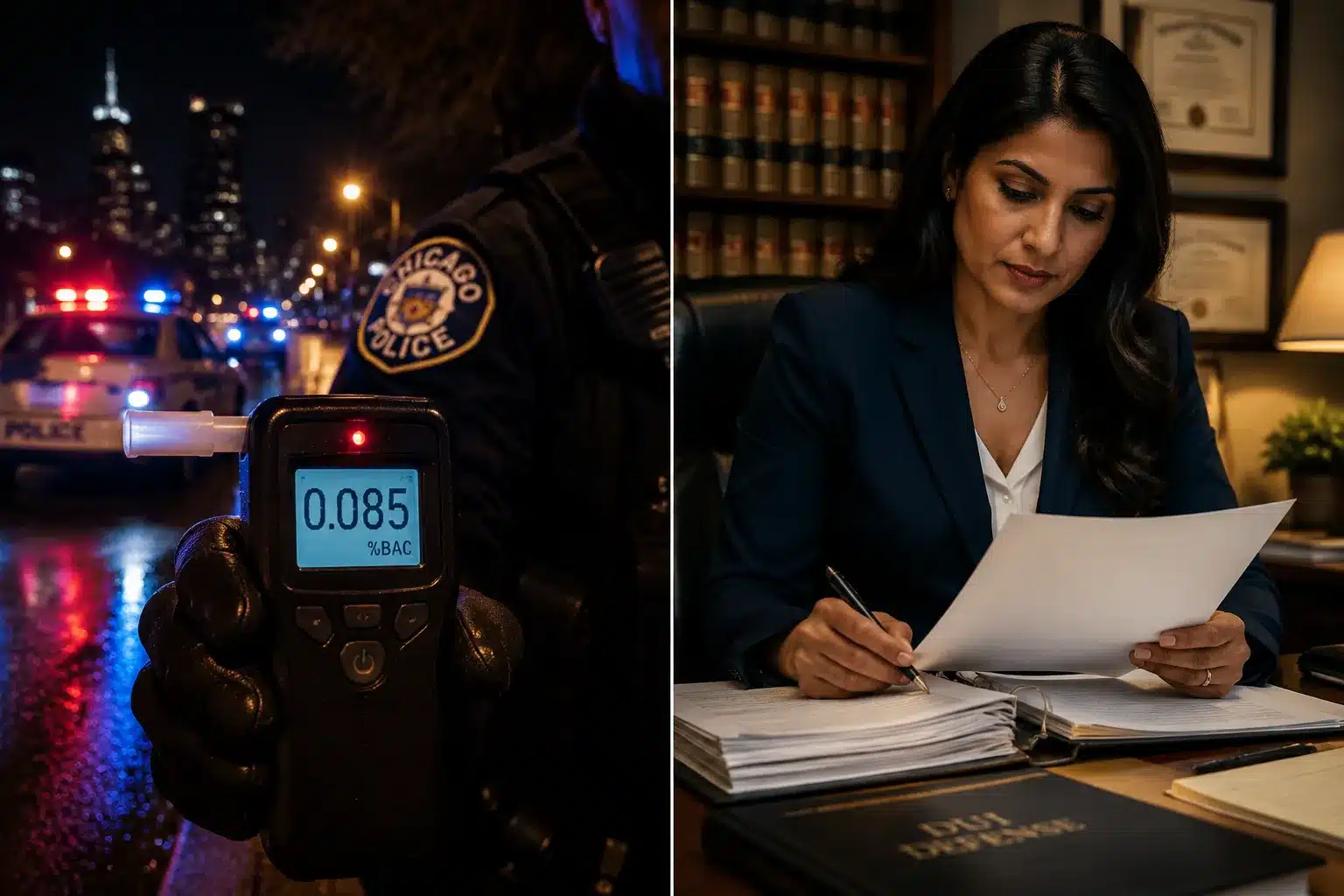
A breathalyzer estimates blood alcohol concentration (BAC) by measuring alcohol in your breath and applying a conversion formula. Illinois uses a legal limit of 0.08% BAC for standard DUI charges [2].
Breathalyzer results can be challenged for several proven reasons:
- Improper calibration, Devices must be calibrated and maintained on a strict schedule. Records showing missed calibrations can undermine the result.
- Operator error, The officer must follow specific protocols. Deviations matter.
- Medical conditions, Conditions like GERD, acid reflux, or diabetes can produce falsely elevated readings.
- Mouth alcohol, Recent burping, vomiting, or certain dental products can contaminate the sample.
- Radio frequency interference, Electronic interference has been documented as a source of error in some devices.
A motion to suppress breathalyzer evidence is one of the most powerful tools in a DUI defense. If the evidence is suppressed, the State’s case often collapses.
What Happens If You Refuse a Breathalyzer in Cook County?
Refusing a breathalyzer in Illinois triggers an automatic statutory summary suspension that is longer than the suspension for failing the test [5]. This is the implied consent law, by driving in Illinois, you agree to chemical testing.
Suspension lengths for a first offense:
- Failed test (BAC 0.08% or higher): 6-month suspension
- Refused test: 12-month suspension
For a second or subsequent offense within 5 years:
- Failed test: 12-month suspension
- Refused test: 3-year suspension
Refusal does not prevent prosecution. The State can still charge you based on officer observations, field sobriety tests, and other evidence. And the jury can be told you refused, which some prosecutors use to imply consciousness of guilt.
Decision rule: Refusing may seem protective, but the longer suspension and the evidentiary consequences often make it a poor strategic choice. Discuss this with an attorney before your next encounter.
What Is the Difference Between DUI and DWAI in Illinois?
Illinois does not use the term DWAI (Driving While Ability Impaired) as a separate offense, that terminology is used in states like New York and Colorado. In Illinois, the charge is simply DUI, and it applies in two ways [2]:
- Per se DUI: BAC of 0.08% or higher, regardless of observed impairment
- Impairment-based DUI: Any amount of alcohol or drugs that renders the driver incapable of safely operating a vehicle
Illinois also has a zero-tolerance law for drivers under 21, any detectable BAC results in a license suspension, even below 0.08%.
Can a DUI Charge Be Dismissed in Cook County?
Yes, DUI charges are dismissed in Cook County, but it requires a proven defense strategy and local experience with how Cook County judges and prosecutors operate [3][6].
Common grounds for dismissal or reduction include:
- Unlawful traffic stop, If the officer lacked reasonable suspicion to pull you over, all evidence collected afterward may be suppressed.
- Faulty breathalyzer, Calibration errors, improper administration, or chain-of-custody problems can invalidate the result.
- Unreliable field sobriety tests, These tests have documented reliability problems, especially for older adults, people with physical conditions, or uneven road surfaces. See why field sobriety tests are not always reliable.
- Miranda violations, Statements made without proper advisement may be excluded.
- Procedural errors, Missed deadlines, improper charging documents, or lab errors can create dismissal opportunities.
A charge reduction to reckless driving, sometimes called a “wet reckless”, is another outcome that avoids the DUI label and its mandatory revocation consequences.
How Long Does a DUI Case Take in Cook County Courts?
A DUI case in Cook County typically takes between 6 and 18 months from arrest to resolution [3]. Several factors affect the timeline:
- Complexity of evidence, Cases involving blood draws, accident reconstruction, or expert witnesses take longer.
- Court backlog, Cook County courts handle a high volume of cases. Scheduling delays are common.
- Pretrial motions, Filing motions to suppress adds time but often produces the best results.
- Plea negotiations, If the State makes an early offer, some cases resolve faster.
The license suspension timeline runs separately and on a much faster clock, the statutory summary suspension begins 46 days after arrest, and the petition to rescind must be filed within 90 days [5].
Do You Need a Lawyer for a DUI Charge in Cook County?
Yes, and not just any lawyer. A DUI charge in Cook County carries consequences that follow you for life, including mandatory license revocation, potential jail time, and a permanent criminal record that cannot be expunged. The stakes demand aggressive, local representation [6].
A skilled Cook County DUI attorney will:
- File a petition to rescind the statutory summary suspension before the 46-day deadline
- Review all police reports, dashcam footage, body camera footage, and breathalyzer calibration records
- Challenge the legality of the traffic stop and arrest
- Negotiate with the Cook County State’s Attorney for a reduction or dismissal
- Prepare a trial defense if no acceptable resolution is available
For guidance on finding the right criminal defense lawyer in Cook County, including what questions to ask and what experience to look for, that resource is a strong starting point.
How Much Does a DUI Lawyer Cost in Cook County?
DUI attorney fees in Cook County vary based on case complexity, the attorney’s experience, and whether the case goes to trial. General ranges (estimates only, actual fees depend on the specific case):
- Misdemeanor first-offense DUI: Flat fees typically range from $2,500 to $7,500
- Felony or aggravated DUI: Fees often start at $7,500 and can exceed $20,000 for trial
- License reinstatement hearing: Often billed separately, typically $1,500 to $3,500
Many Cook County DUI attorneys offer free initial consultations. The cost of a lawyer is almost always less than the long-term cost of a conviction, which includes fines, insurance rate increases, potential job loss, and the permanent record.
Can a DUI Be Expunged from Your Record in Illinois?
No. A DUI conviction in Illinois cannot be expunged or sealed. This is one of the most important reasons to fight a DUI charge rather than accept a quick plea [4][5].
However, there are limited exceptions:
- Supervision (not a conviction): If you receive court supervision and successfully complete it, the arrest may be eligible for expungement after the supervision period ends. Supervision is generally only available for a first-time DUI.
- Acquittal or dismissal: If the charge is dismissed or you are found not guilty, the arrest record may be expunged.
The bottom line: Because a DUI conviction stays on your record permanently, the fight to avoid conviction is worth every effort. An experienced attorney can often secure supervision or a charge reduction that preserves your eligibility for expungement.
What Are Common Mistakes People Make After a DUI Arrest?
These are the errors that consistently hurt DUI defendants in Cook County [6]:
- Waiting too long to hire an attorney, Missing the 90-day window to petition for rescission of the license suspension is irreversible.
- Talking to police without a lawyer, Anything you say will be used against you. Silence is protected; explanations are not.
- Assuming a first offense means no real consequences, A first DUI still means mandatory revocation, a permanent record, and potential jail time.
- Posting on social media, Prosecutors and investigators monitor social media. Photos, check-ins, and comments can become evidence.
- Accepting the first plea offer without analysis, The State’s first offer is rarely the best one. An attorney with local experience knows what Cook County prosecutors will and won’t accept.
- Ignoring the administrative license case, Many defendants focus only on the criminal case and miss the separate deadline to fight the suspension.
For a broader look at the 3 rules to survive an arrest in Cook County, those principles apply directly to DUI situations.
Frequently Asked Questions
Q: What is the legal BAC limit in Illinois? A: The limit is 0.08% for drivers 21 and older. For commercial drivers, it is 0.04%. For drivers under 21, any detectable amount triggers the zero-tolerance law.
Q: Will I lose my license immediately after a DUI arrest? A: Not immediately. The statutory summary suspension begins 46 days after your arrest. You have 90 days to petition to rescind it. Act fast, this deadline is firm [5].
Q: Can I drive after a DUI arrest while my case is pending? A: Yes, during the first 45 days after arrest. After that, the suspension kicks in unless you successfully petition to rescind it or obtain a monitoring device driving permit (MDDP) [5].
Q: What is an MDDP? A: A Monitoring Device Driving Permit allows first-time DUI offenders to drive during the summary suspension period if they install an ignition interlock device (BAIID) in their vehicle.
Q: Does a DUI affect my auto insurance in Illinois? A: Yes. A DUI conviction typically results in significantly higher premiums or policy cancellation. Illinois requires an SR-22 certificate for license reinstatement after a DUI revocation.
Q: What happens if I get a DUI while on probation in Cook County? A: A DUI arrest while on probation for another offense can trigger a violation of probation hearing, potentially resulting in revocation of probation and imposition of the original sentence. This is a serious situation requiring immediate legal help.
Q: Can I represent myself in a Cook County DUI case? A: Technically yes, but it is strongly inadvisable. DUI cases involve technical evidence, procedural rules, and local court practices that take years to master. Self-representation almost always produces worse outcomes.
Q: What is aggravated DUI in Illinois? A: Aggravated DUI is a felony-level charge triggered by factors such as: a child passenger under 16, causing great bodily harm or death, driving without a valid license, or a third or subsequent DUI offense [4].
Q: How does the Cook County State’s Attorney approach DUI cases? A: Cook County prosecutors generally pursue DUI charges aggressively, particularly when there is a prior record or aggravating circumstances. Local experience with how individual courtrooms and prosecutors operate is a genuine advantage.
Q: What is a “wet reckless” in Illinois? A: A “wet reckless” is a charge reduction from DUI to reckless driving with an alcohol notation. It avoids mandatory revocation and carries lesser penalties, but it still counts as a prior offense if you are charged with DUI again.
Conclusion
Being arrested for DUI in Cook County is serious, but it is not the end of the road. The process that follows involves two parallel fights: defending the criminal charge and protecting your driver’s license. Both require immediate action, proven strategy, and local experience with Cook County courts.
Your action steps right now:
- Say nothing to police beyond basic identification, invoke your right to counsel.
- Contact a Cook County DUI defense attorney within 24 hours of your arrest.
- Note every detail of the stop and arrest while your memory is fresh.
- Understand that the 46-day clock on your license suspension is already running.
- Do not plead guilty without a full review of the evidence against you.
A DUI conviction in Illinois cannot be expunged. The fight to avoid that outcome starts today, not next week. With the right defense, charges can be dismissed, reduced, or fought at trial. Control what you can, starting now.


